Author: marketing@datasciencewizards.ai

  • Enabling Secure, Governed Agentic Intelligence Across BFSI Workflows

    Enabling Secure, Governed Agentic Intelligence Across BFSI Workflows

    Why autonomy in financial services must be built on regulatory-grade security and oversight

    Artificial intelligence in banking and insurance is moving beyond copilots and chat assistants. The next evolution is agentic intelligence AI systems capable of autonomously executing structured, multi-step workflows across underwriting, credit assessment, claims processing, fraud detection, and regulatory reporting.

    For banks and insurers operating under stringent regulatory frameworks, this shift is transformative but also sensitive. Unlike retail or media sectors, BFSI institutions manage regulated capital, personally identifiable financial data, health disclosures, and cross-border compliance obligations. In this context, autonomy without governance is not innovation; it is exposure.

    The opportunity lies in deploying AI agents that operate securely within defined policy boundaries, accelerating workflows while preserving auditability, explainability, and regulatory control.

    From Task Automation to Workflow Ownership

    In insurance and banking environments, workflows are document-heavy, rules-driven, and compliance-intensive.

    Consider insurance underwriting. Today, underwriters manually review proposal forms, medical records, financial statements, and prior policy histories before assigning risk classifications. An agentic system can ingest structured and unstructured data, extract relevant risk indicators, cross-reference underwriting guidelines, and prepare a pre-assessment summary, reducing turnaround time while improving consistency.

    In retail banking, AI agents can support credit risk evaluation by consolidating customer income data, repayment histories, bureau reports, and internal exposure limits before recommending lending decisions aligned to policy thresholds.

    Similarly, in claims processing, an AI agent can validate documentation completeness, flag inconsistencies, detect potential fraud patterns, and initiate settlement workflows escalating complex or high-value cases to human review.

    The efficiency gains are substantial. However, these workflows directly affect capital allocation, regulatory reporting, and customer financial wellbeing. This is where secure design becomes essential.

    Embedding Security at the Workflow Level

    In BFSI, security must be granular and contextual.

    Role-aligned access controls ensure AI agents inherit the same permissions as the teams they augment. An underwriting agent should not access claims investigation data unless explicitly authorised. A lending agent should operate within predefined credit policy constraints.

    Data boundary management is equally critical. Sensitive customer data health disclosures in life insurance, transaction histories in banking must remain within controlled environments. Secure model hosting, encryption, tokenisation, and strict outbound prompt filtering prevent unintended data leakage to external systems.

    Controlled execution rights ensure agents cannot unilaterally approve high-risk actions. For example, a commercial loan above a certain threshold or a large insurance payout may automatically trigger human approval gates.

    Security is not about limiting automation; it is about maintaining institutional safeguards while enabling speed.

    Governance: The Regulatory Imperative

    Banks and insurers operate under continuous regulatory scrutiny from capital adequacy frameworks to consumer protection laws. Agentic systems must therefore be auditable by design.

    Every AI-driven recommendation or action must generate a verifiable decision trail:

    • What data inputs were used?
    • Which internal policies were referenced?
    • What reasoning path led to the output?
    • Was human intervention applied?

    Explainability is particularly critical in lending and underwriting decisions, where fairness and bias mitigation are regulatory priorities. Governance frameworks should include model validation, bias monitoring, and periodic performance reviews aligned to compliance standards.

    Human-in-the-loop controls remain non-negotiable. Straight-through processing may apply to low-risk retail claims or small-ticket loans, but complex medical underwriting or corporate lending requires structured oversight.

    Building Enterprise-Grade Agent Infrastructure

    Scaling agentic intelligence across banking and insurance requires more than isolated pilots. Institutions must establish:

    • Private or sovereign AI environments aligned to data residency obligations.
    • Centralised orchestration layers to manage agent permissions, integrations, and lifecycle controls.
    • Real-time monitoring dashboards for compliance, risk, and operational visibility.
    • Model risk management processes aligned to existing governance committees.

    By integrating AI oversight into existing risk frameworks rather than creating parallel structures, institutions can accelerate adoption without compromising control.

    Competitive Advantage Through Governed Autonomy

    Customer expectations in financial services continue to rise. Policyholders expect faster claims settlements. Borrowers expect near-instant credit decisions. Regulators expect transparency and fairness.

    Agentic intelligence can deliver speed and scale but only when deployed within robust security and governance architectures.

    The institutions that will lead are not those that automate fastest, but those that embed autonomy responsibly. Secure, governed AI agents can reduce underwriting turnaround times, improve fraud detection accuracy, enhance compliance monitoring, and free skilled professionals to focus on complex, high-value decisions.

    For banks and insurers, the future is not human versus machine. It is structured collaboration where AI agents operate within clearly defined regulatory guardrails, and human expertise provides judgment where it matters most.

    In financial services, trust is the ultimate differentiator. Governed agentic intelligence ensures that innovation strengthens that trust rather than undermines it.


  • Redesigning High-Integrity Financial Operations through Agentic AI-Driven Transformation

    Redesigning High-Integrity Financial Operations through Agentic AI-Driven Transformation

    Financial operations within banks and insurance firms sit at the intersection of risk, regulation, and customer trust. From policy issuance and claims settlement to loan processing, reconciliations, and regulatory reporting, these functions demand absolute accuracy, auditability, and resilience.

    While digital transformation has streamlined interfaces and analytics, core financial operations remain heavily dependent on manual validation, fragmented systems, and layered oversight. The next phase of transformation is emerging through Agentic AI — autonomous systems capable of executing structured, multi-step workflows within defined policy and governance boundaries.

    For financial institutions, the opportunity is not simply automation. It is the redesign of high-integrity operations, embedding intelligence directly into the operational fabric while preserving control.

    The Integrity Imperative in Financial Operations

    Unlike other industries, operational errors in banking and insurance carry regulatory, financial, and reputational consequences. A misclassified underwriting risk affects capital adequacy. An incorrectly processed claim impacts reserves and compliance reporting. A flawed loan approval exposes credit risk and regulatory scrutiny.

    High-integrity operations require:

    • Deterministic workflows aligned to policy frameworks
    • Strong segregation of duties
    • Full audit trails
    • Continuous regulatory alignment

    Traditional automation has addressed isolated tasks. Agentic AI enables orchestration across entire operational chains.

    Where Agentic AI Transforms Banking Operations

    In banking, financial operations span credit risk assessment, treasury management, reconciliations, anti-money laundering (AML) reviews, and regulatory reporting.

    An agentic AI system can:

    • Consolidate borrower financial data, bureau scores, transaction histories, and internal exposure limits to generate structured credit recommendations aligned to lending policy.
    • Automate multi-system reconciliations by identifying mismatches across ledger systems and flagging anomalies for review.
    • Support AML teams by cross-referencing transaction patterns against evolving compliance rules and escalating high-risk cases.

    Crucially, these agents operate within predefined risk thresholds. High-value loans, unusual exposure patterns, or regulatory exceptions trigger human oversight, maintaining governance discipline.

    The result is faster processing without eroding control frameworks.

    Reinventing Insurance Financial Workflows

    Insurance operations are particularly document-intensive and risk-sensitive. Underwriting, claims adjudication, premium accounting, reinsurance calculations, and reserve reporting all demand precision.

    Agentic AI can:

    • Ingest medical disclosures, financial records, and historical policy data to prepare underwriting summaries aligned to risk guidelines.
    • Validate claims documentation, cross-check policy terms, assess fraud indicators, and initiate settlement workflows.
    • Automate premium reconciliation and flag discrepancies between policy administration systems and finance ledgers.
    • Assist actuarial and finance teams by aggregating claims trends and exposure data for reserve calculations.

    These capabilities reduce turnaround times and operational leakage while improving consistency across distributed teams.

    However, autonomy must coexist with regulatory guardrails.

    Governance as the Foundation of Agentic Transformation

    Financial operations in banks and insurers operate under frameworks such as capital adequacy requirements, solvency regimes, consumer protection mandates, and data privacy laws. Any AI-driven transformation must be auditable by design.

    This requires:

    Embedded Policy Controls
    Agents must reference approved underwriting guidelines, credit policies, and compliance rules before generating outputs.

    Full Decision Traceability
    Every recommendation or automated action should generate a time-stamped record of inputs, rules applied, and reasoning pathways.

    Segregation of Duties by Design
    AI systems must respect operational boundaries, preventing conflicts such as simultaneous approval and reconciliation within the same workflow.

    Model Risk Oversight
    Ongoing monitoring for drift, bias, or performance degradation ensures alignment with risk management standards.

    By integrating agent governance into existing operational risk committees and compliance frameworks, institutions avoid creating parallel oversight structures.

    From Automation to Operational Redesign

    The strategic shift is not deploying AI into legacy processes, but redesigning those processes around intelligent orchestration.

    Agentic AI enables:

    • Straight-through processing for low-risk, high-volume transactions
    • Structured escalation models for complex or high-value cases
    • Continuous compliance monitoring rather than periodic review
    • Real-time operational visibility across finance and risk teams

    This creates a hybrid operating model — where human expertise focuses on judgment-intensive decisions, and AI agents manage structured, repeatable workflows at scale.

    Competitive Advantage Through Controlled Intelligence

    For banks and insurers, trust remains the ultimate differentiator. Customers expect faster claims settlements and near-instant credit decisions. Regulators expect transparency. Boards expect resilience.

    Agentic AI-driven transformation offers a path to modernise financial operations without sacrificing integrity. By embedding governance into architecture, enforcing policy-driven execution, and maintaining human oversight at critical thresholds, institutions can achieve operational speed while strengthening compliance posture.

    The future of financial operations will not be defined by automation alone. It will be defined by high-integrity intelligence, systems that act autonomously, but always within the boundaries of regulatory, financial, and ethical accountability.

    For banking and insurance leaders, the mandate is clear: redesign operations not just for efficiency, but for governed intelligence at scale.

  • Agentic AI in BFSI: From Workflow Automation to Autonomous, Audit-Ready Decision Systems

    Agentic AI in BFSI: From Workflow Automation to Autonomous, Audit-Ready Decision Systems

    Introduction: Why BFSI Needs More Than Automation

    Over the last decade, BFSI organisations, particularly insurers, have invested heavily in automation, analytics, and artificial intelligence. While these investments have delivered measurable efficiency gains, most enterprise systems still operate within predefined workflows, rigid business rules, or isolated predictive models.

    Such systems perform well in structured scenarios, but they struggle in environments that demand contextual reasoning, multi-step decision-making, real-time adaptability, and regulatory-grade explainability.

    As BFSI moves toward faster decision cycles and higher autonomy, incremental automation is no longer sufficient. The next evolution is Agentic AI — systems capable of reasoning, acting, and making decisions autonomously, while remaining governed, traceable, and audit-ready.

    From Automation to Agentic Systems

    In practice, BFSI organisations are beginning to distinguish between two foundational layers of intelligent decision making, each with a distinct responsibility and governance model.

    The Agentic Intelligence Layer focuses on reasoning and orchestration. It interprets intent, evaluates contextual information, consults policies and guidelines, and determines the next best action. These systems increasingly support functions such as customer servicing, claims triage, underwriting assistance, compliance monitoring, and field-sales enablement.

    The AI/ML Decision Backbone underpins predictive intelligence. It is responsible for data ingestion, feature management, model development, inference, monitoring, and regulatory-grade governance. This layer ensures that predictive signals — such as risk scores or fraud probabilities are accurate, explainable, and auditable.

    This separation is intentional. It allows organisations to scale autonomous decision-making without embedding risk, opacity, or compliance gaps into the intelligence layer itself.

    How Agentic AI and Predictive Models Work Together

    Agentic systems do not replace predictive models; they operationalise them. An agent may request a fraud probability, a risk classification, or a churn score, and then incorporate that signal into a broader decision that also considers policy rules, customer context, and process constraints.

    Crucially, predictive models remain independently governed and monitored. The agent consumes their outputs without obscuring model logic, lineage, or accountability, an approach that aligns well with regulatory expectations in BFSI.

    Claims Triage with Audit-Ready Decisions
    Agentic systems assess claim narratives, documents, and contextual signals, while predictive models provide fraud and risk indicators. Based on this combined intelligence, claims can be routed for straight-through processing, fast-track settlement, or deeper investigation, with each decision fully traceable.

    Underwriting Decision Support
    Agentic intelligence interprets underwriting rules alongside applicant context, while predictive models contribute mortality, risk, and pricing insights. Recommendations are generated consistently, with clear reasoning and the ability to escalate to human underwriters where required.

    Field-Level Sales Enablement
    Agentic assistants support field agents in real time by aligning customer conversations with predictive insights on product suitability and long-term value, while ensuring adherence to compliance and suitability norms throughout the interaction.

    Compliance and Audit Automation
    Agentic systems continuously evaluate decisions against internal policies and regulatory expectations, while predictive systems provide full model lineage, performance monitoring, and drift detection. This allows auditors and risk teams to trace outcomes from decision to data source without manual reconstruction.

    Why This Shift Matters for BFSI

    Many AI initiatives in BFSI struggle not because of weak models, but because autonomy and governance are treated as opposing forces. Language models are often pushed beyond their role, predictive systems lack sufficient oversight, and compliance is addressed too late in the lifecycle.

    Agentic AI, when designed with clear boundaries and governed intelligence foundations, enables organisations to move faster without sacrificing trust.

    Autonomous, but Accountable

    The future of BFSI decisioning lies not in replacing human judgment, but in scaling it responsibly. Agentic AI represents a shift from task automation to accountable autonomy where systems can reason, act, and explain their decisions in ways regulators, auditors, and customers can trust.

    In a highly regulated industry, this balance will increasingly define which organisations are able to innovate sustainably, and which remain constrained by legacy automation paradigms.

  • Designing trustworthy intelligent systems: A regulatory blueprint for Agentic AI in BFSI

    Designing trustworthy intelligent systems: A regulatory blueprint for Agentic AI in BFSI

    Artificial intelligence in BFSI has long been driven by use cases fraud detection, credit decisioning, risk analytics, customer service, and operational efficiency. What has evolved over time is how institutions have approached enabling these use cases at scale.

    The journey began with tools, enabling experimentation and early innovation.
    It progressed to frameworks, introducing structure, standards, and repeatability.
    It then matured into platforms, supporting adoption across teams, data estates, and enterprise functions.

    Each phase represented meaningful progress in applying AI responsibly within regulated environments.

    Today, BFSI institutions are engaging with a deeper, more structural question:

    How do we operate AI especially agentic AI safely, at scale, and in line with regulatory expectations as part of the enterprise itself?

    This question does not replace innovation. It reflects a natural progression toward institutional trust, accountability, and long-term resilience.

    From AI adoption to AI operation in BFSI

    As AI moves from isolated applications into core banking systems, insurance operations, and risk workflows, the focus expands beyond selecting the right tool or platform.

    Institutions are increasingly designing for:

    * Continuous AI operation, not episodic deployments
    * Governance that executes as code, rather than static policy documents
    * Data sovereignty and institutional custody by design
    * Auditability, traceability, and reversibility at runtime
    * Safe integration of a growing ecosystem of models, agents, tools, and infrastructure

    In regulated environments, these are foundational considerations. Together, they define what it means to build trustworthy intelligent systems.

    This evolution mirrors earlier transitions in BFSI technology from standalone applications to core banking platforms, and from infrastructure components to operating models designed for scale, resilience, and regulatory confidence.

    Agentic AI raises the bar for governance

    Agentic AI introduces a new capability: systems that can plan, coordinate, and act across workflows.

    As this capability becomes operational, governance questions naturally evolve:

    Under which policy was an action authorized?
    Can decisions be traced, explained, and audited?
    Are outcomes reversible when required?
    How is lifecycle managed — from creation to retirement?

    These are not questions of algorithms alone. They are system-design questions.

    As agentic AI becomes embedded in BFSI operations, institutions require governance that is embedded, enforceable, and observable at runtime, rather than dependent on post-hoc review processes.

    The role of an Enterprise AI Operating System

    This is where the concept of an Enterprise AI Operating System becomes relevant.

    An Enterprise AI OS represents a foundational architectural layer that defines how AI and agentic systems are built, deployed, orchestrated, and governed across the institution, independent of individual tools or vendors.

    Key characteristics of this approach include:

    Governance embedded at the system level, executed programmatically
    AI/ML and agentic runtimes operating as governed subsystems
    On-premises, private-cloud, and hybrid deployment by design
    Full institutional custody of models, agents, workflows, and source code
    Freedom of choice across infrastructure and tools, without enforced lock-in

    This operating layer enables BFSI institutions to integrate internal systems, partner ecosystems, open-source models, and cloud services under a single governed control plane, aligned with regulatory expectations.

    A regulatory-aligned evolution

    The progression from tools to frameworks to platforms reflects a broader shift in how BFSI institutions think about technology adoption.

    As AI becomes a long-running, decision-influencing capability, institutions increasingly design for operation, continuity, and oversight, rather than one-time deployment.

    This evolution acknowledges a simple reality: BFSI institutions do not just need to build AI they need to operate AI as a trusted institutional capability over time. That requires architectural thinking grounded in systems, controls, and governance, rather than features alone.

    From platforms to regulated intelligent systems

    Platforms help teams build AI capabilities. Operating systems enable institutions to live with AI over years, across environments, audits, and regulatory change.

    As agentic AI becomes part of the operational fabric, the future of BFSI will be shaped not only by innovation, but by how intelligently systems are governed, controlled, and trusted at scale.

    Designing trustworthy intelligent systems is no longer just a technology challenge. It is an architectural and regulatory imperative.

  • The Missing Architecture of Insurance AI: Why India Must Shift From Use Cases to Systems

    The Missing Architecture of Insurance AI: Why India Must Shift From Use Cases to Systems

    For some time now, the insurance industry has adopted AI in fragments — a fraud model here, a claims bot there, and an underwriting score somewhere else. Most of these initiatives succeed in isolation. Yet, when insurers attempt to scale them across a business line or a policy lifecycle, they confront a surprising bottleneck: the problem is not the model; the problem is the system around it.

    India’s insurance sector is at a pivotal point. Digital adoption is strong, regulators are encouraging innovation, and customer expectations are rising faster than product cycles. But the real breakthrough we need next will not come from “more models.” It will come from re-engineering the systems in which AI operates.

    This shift from task automation to system orchestration is where the next decade of InsurTech innovation will unfold.

    AI Works… Until It Has to Work With Everything Else

    Ask any insurer why AI pilots stall. The answers sound similar across motor, health, life, and commercial lines:

    • The model works, but the workflow doesn’t accept its output.

    • A fraud score triggers flags but doesn’t integrate with claims approval systems.

    • Underwriting recommendations do not align with policy rules or pricing engines.

    • Audit trails are inconsistent because each tool records decisions differently.

    • Scaling across states, regions, or business lines creates inconsistencies.

    These issues are not mathematical failures; they are architectural ones. Insurers don’t lack algorithms. They need systems that coordinate algorithms across the enterprise. And this is exactly where India’s next leap in AI-enabled insurance will be defined. The System Lens: Why Insurance Must Think Beyond Just Models. Insurance is a system business, not a task business.

    A claim settlement is not a single AI event. It is a series of tightly coupled steps:

    1. Intake and documentation

    2. Policy validation

    3. Coverage interpretation

    4. Fraud risk scoring

    5. Medical or repair estimation

    6. Decisioning

    7. Communication and settlement

    Each step may use AI, yet the value emerges only when these steps work together coherently. This is why insurers must adopt a system lens for AI:

    • Shared constraints across models

    • Common policy logic woven into algorithms

    • Unified audit trails for every AI-assisted action

    • Enterprise-wide coordination between underwriting, claims, risk, compliance, and distribution

    The industry doesn’t need more use cases. It needs coordinated intelligence across use cases.

    Agentic AI: Not Just Faster , but Also Redesigned Systems. Globally, insurance is entering the era of agentic AI, where software doesn’t just recommend but initiates, coordinates, and adapts actions.

    In insurance, this looks like:

    • Claims intake agents that gather documents, classify them, cross-verify coverage, and prepare assessors’ summaries.

    • Underwriting agents that pull risk data, compare historical patterns, apply rules, and escalate exceptions.

    • Fraud agents that correlate signals across multiple policies, networks, and historical claims.

    • Customer service agents that resolve routine queries end-to-end with auditability built in.

    But here is the catch:

    Agentic AI cannot be deployed safely unless the governance layer and system constraints are redesigned first.

    This means:

    • Policies become executable rules, not PDF manuals.

    • Compliance becomes runtime enforcement, not post-facto documentation.

    • Data lineage, visibility, and accountability become first-class citizens of system design.

    • Human oversight is embedded into workflows, not as an afterthought but as a principle.

    Agentic AI is not a shortcut to automation.

    It is an opportunity to reimagine insurance systems around new forms of intelligence. Where India Can Lead the World . India has some unique structural advantages:

    1. Digital Public Infrastructure (DPI) Mindset

    UPI and Account Aggregator (AA) demonstrate that India understands how to build coordinated, interoperable digital systems at scale.

    Insurance AI can benefit from the same architectural mindset: shared pipes, shared logic, shared trust frameworks.

    2. Abundance of Talent Across Tech + Insurance

    India’s actuarial, data engineering, and AI talent pools are deep and growing. What the industry needs next is a systems-oriented skill set — architects who understand insurance operations as deeply as they understand AI models.

    3. Regulatory Momentum

    IRDAI’s push toward “Insurance for All by 2047” opens the door for systemic innovation.

    4. InsurTech’s Increasing Role in Core Transformation

    Indian InsurTechs are no longer just distribution players. They are influencing underwriting, pricing, risk, fraud, and servicing the core engine of insurance.

    A Practical Blueprint: How Insurers Can Begin

    1. Define the “Statement of Business Purpose” for every AI initiative

    2. Build shared governance before scaling autonomy

    3. Create a unified decision architecture

    4. Keep humans in the loop where judgment matters

    5. Treat AI platforms as infrastructure, not tools

    The Next Frontier: Insurance as Coordinated Intelligence

    If India embraces a system-based approach to AI:

    • Claims could move from reaction to anticipation.

    • Underwriting could become dynamically context-aware.

    • Fraud detection could evolve into network-level intelligence.

    • Customer experience could shift from reactive service to proactive guidance.

    Insurance has always been a data business. Now it can become a coordinated intelligence business.

    The opportunity ahead is immense, not because of what just models can do, but because of how systems can be redesigned to let AI operate safely, meaningfully, and at scale.

    The chasm between pilots and production isn’t a technology gap. It’s a system gap. And closing it is where the next decade of Indian InsurTech innovation will be written.

  • Why BFSI needs a governance-first approach to scalable & explainable agentic intelligence

    Why BFSI needs a governance-first approach to scalable & explainable agentic intelligence

    Digital transformation has modernized financial institutions in meaningful ways — core modernization, API ecosystems, cloud-native platforms, and analytics-led automation. Yet the industry continues to ask the same question: Why doesn’t transformation feel complete?

    A compelling framing comes from Sangeet Paul Choudary, who highlights that tasks exist only in relation to a system, and organizational workflows are defined not by individual steps but by system-wide constraints and coordination. This perspective is particularly relevant as the industry enters the era of agentic AI — where AI doesn’t just recommend actions, but autonomously initiates and coordinates workflows across the enterprise.

    The challenge ahead is no longer automating tasks. It is redesigning systems.

    Agentic AI changes the unit of transformation

    Traditional digital initiatives improve discrete workflows:

    • document verification,
    • claim settlement,
    • fraud alerts,
    • credit scoring

    Agentic AI changes the playing field. It:

    • initiates actions,
    • coordinates across silos,
    • reasons with context,
    • and adapts to outcomes.

    The shift is from task automation to system orchestration.
    Value will increasingly come from how decisions connect — not how fast individual tasks execute.

    This requires a new organizing principle.

    Why governance must come before scale

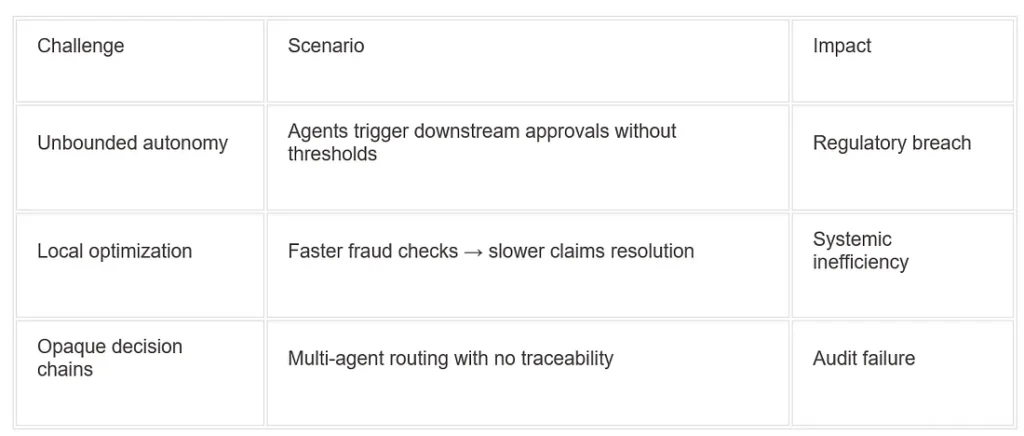
    In BFSI, the risk of AI is not simply “wrong output” — it is uncontrolled action.

    If autonomy scales without shared constraints, three failures emerge:

    In traditional AI, governance is a reporting layer.
    With Agentic AI, governance becomes the execution layer.

    The operating question shifts from “How do we automate?” to “How do we govern intelligence that operates inside regulated systems?”

    The system lens: From use cases to architectural design

    Most institutions still frame AI adoption as a pipeline of use cases.
    But use cases are atomic units; systems create value.

    A claims agent, underwriting agent, fraud agent, and CX agent create transformation only when they operate under:

    • shared regulatory constraints,
    • unified policy logic,
    • consistent audit and entitlements,
    • cross-system orchestration.

    Without systemic design, scaling AI produces fragmentation — not transformation.

    Four Architecture shifts BFSI must make to AI that operates like infrastructure, not tooling.

    1. From Model-Centric to Policy-Centric Design

    Models evolve rapidly; policies define continuity and compliance.

    1. From Agent Autonomy to Coordinated Autonomy

    Single-agent efficiency means little without cross-agent coordination.

    1. From Compliance as Documentation to Compliance as Code

    Controls must be executed at runtime, not validated afterward.

    1. From Workflow Silos to Decision Networks

    Decision fabrics, not linear flows, will define competitive advantage.

    Together, these shifts create AI that operates like infrastructure, not tooling.

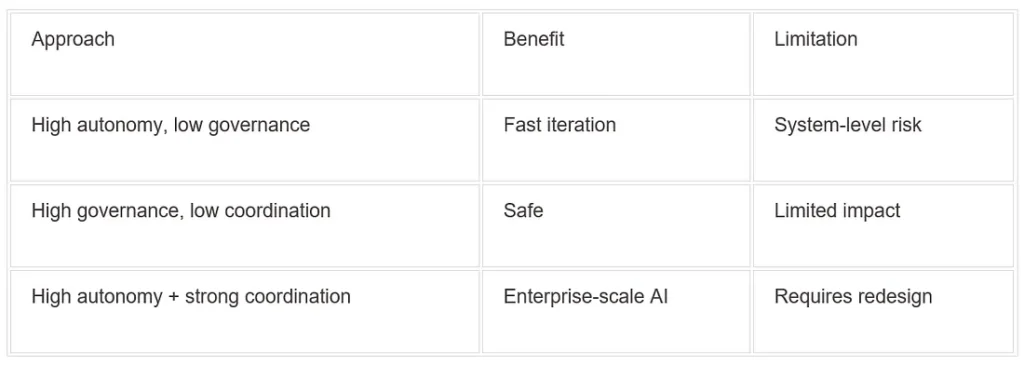
    The autonomy–coordination trade-off

    Scaling AI is not a question of compute or bandwidth — it is a question of control.

    The institutions that strike this balance will scale safely and defensibly. Those that don’t will move faster than they can control.

    What BFSI must do now to move from AI pilots to institutional infrastructure.

    To operationalize Agentic AI responsibly, institutions must:

    • Treat policies as executable logic
    • Govern actions before execution, not after
    • Build agents that operate under shared constraints
    • Design AI as a system, not a toolset
    • Make governance core to architecture, not an add-on

    This is how BFSI moves from pilots to institutional infrastructure.

    Not just AI that predicts — but AI that performs transparently, safely, and at scale.

    And that shift begins not with algorithms, but with governance.

  • BFSI fraud detection gets smarter with UnifyAI

    BFSI fraud detection gets smarter with UnifyAI

    What is the founding vision behind Data Science Wizards, and how does it differentiate itself from other AI platform providers?

    The founding vision of Data Science Wizards (DSW) has been to make AI adoption real, scalable, and responsible for enterprises. Over the years, AI deployments often stalled in ‘pilot mode,’ not because of lack of technology, but because enterprises lacked an infrastructure layer to embed AI into the core of their operations.

    DSW’s UnifyAI was built to address this gap. It is not another AI tool; it is the OS for Enterprise AI — a platform that unifies the lifecycle of data, models, agents, governance, and deployment. This allows enterprises to move from isolated experiments to production-grade AI systems at speed and with confidence.

    What differentiates us is:

    • A unified lifecycle that connects data to deployment seamlessly.
    • Enterprise-grade governance, ensuring AI is usable even in highly regulated industries.
    • Deployment flexibility without lock-in, across on-premises, hybrid, or cloud environments.

    In essence, UnifyAI helps enterprises treat AI not as an add-on, but as a foundational business capability.

    How does UnifyAI handle hybrid AI execution across cloud and on-premise environments?

    Hybrid execution is a foundational principle of UnifyAI’s architecture. In BFSI and other regulated industries, critical workloads cannot reside fully on public cloud due to compliance, data residency, and security requirements. At the same time, enterprises need the elasticity of cloud to scale compute-heavy workloads such as model training or GenAI use cases.

    UnifyAI addresses this by being infrastructure-agnostic. It enables enterprises to deploy and run AI seamlessly across on-premises, private cloud, and public cloud environments without changing the way teams build or govern their models.

    Key to this is a centralised control plane that provides governance, observability, and policy enforcement across all environments. Every model, workflow, and decision is traceable and explainable, ensuring enterprises can scale AI adoption responsibly while meeting regulatory expectations.

    With this approach, organisations can keep sensitive workloads in-house, leverage cloud where scale is required, and operate with full flexibility — all without vendor lock-in.

    What impact has insurAInce had on reducing claims fraud and improving persistency prediction in live deployments?

    insurAInce, built on UnifyAI, is our flagship vertical solution for insurers. It addresses two of the most critical business priorities in the industry:

    Claims fraud detection: By combining GenAI-driven document parsing with anomaly detection, insurAInce enables insurers to identify fraudulent claims earlier and handle them at scale with greater efficiency. This not only reduces financial leakage but also accelerates claims resolution, strengthening customer trust.

    Persistency prediction: Predictive models that leverage both structured policyholder data and unstructured sources like call transcripts generate early warning signals for lapses. This allows insurers to engage proactively with customers, improving retention and protecting long-term profitability.

    What makes insurAInce impactful is not just the sophistication of its models, but the governance and explainability embedded in every workflow. With UnifyAI as the backbone, insurers gain a system that scales predictably, learns continuously from ground-level feedback, and delivers insights they can trust in highly regulated environments.

    For BFSI clients, how does your platform improve fraud detection accuracy while keeping false positives low?

    Fraud detection is only valuable if accuracy is achieved without overburdening teams with false positives. UnifyAI improves this balance through a multi-layered strategy:

    • Hybrid data models capture richer fraud signals by blending structured transactions with unstructured content like chats and documents.
    • Adaptive feedback loops refine models continuously using investigator inputs, improving accuracy over time.
    • Confidence scoring APIs quantify the reliability of predictions, enabling risk-based prioritization.
    • Agentic AI orchestration manages entire fraud investigation workflows, surfacing only cases requiring human judgment.

    The result: BFSI clients achieve higher fraud detection rates while maintaining false positives, ensuring both compliance and customer trust.

    What safeguards are in place to ensure explainability, transparency, and traceability in GenAI-powered workflows?

    Trust is fundamental to AI adoption, and UnifyAI addresses this through a governed GenAI framework that incorporates safeguards at every level. The platform features a Prompt Hub with versioning, ensuring that every prompt, model, and output remains fully auditable. Guardrails and policy enforcement are built into workflows to embed both regulatory and business rules seamlessly.

    Additionally, explainability layers provide context and rationale for outputs, making AI decisions interpretable for users. Complementing this, traceability logs capture the complete decision journey, creating an end-to-end audit trail.

    Together, these measures ensure that GenAI in BFSI and other highly regulated industries does not operate as a ‘black box,’ but rather as a transparent, controlled system that enterprises can adopt with confidence.

    How do you see the role of AI in reshaping risk management and fraud detection in the next 5 years?

    The next five years will bring a fundamental transformation in the way risk and fraud are managed, with humans remaining an essential part of the loop. Three key trends are expected to shape this evolution:

    • Agentic AI systems will autonomously manage end-to-end workflows, from detection to resolution, thereby reducing dependence on manual intervention while ensuring human oversight remains integral.
    • Real-time risk engines will emerge, powered by AI-native infrastructure, enabling dynamic risk scoring across portfolios and transactions with unprecedented speed and accuracy.
    • Collaborative ecosystems will take shape, where banks, insurers, and regulators securely share AI-driven insights. This will strengthen fraud prevention efforts while safeguarding privacy and compliance.

    Overall, risk management will shift from a reactive model to a proactive and predictive one. The enterprises that succeed will be those that embed AI as a core infrastructure layer rather than treating it as a siloed tool while maintaining a balance between automation and human judgment.

  • Transforming BFSI & Enterprise AI with UnifyAI’s Unified Ecosystem

    Transforming BFSI & Enterprise AI with UnifyAI’s Unified Ecosystem

    You’ve worked across insurance, BFSI, and global enterprises before starting DSW. What specific gap in enterprise AI convinced you that UnifyAI needed to exist?

    Across insurance, BFSI, and large global enterprises, I consistently observed similar issues: AI skills and talent exist, tools exist, and data exists — but enterprises are unable to operationalize AI beyond isolated experiments.

    Most organizations were running multiple POCs and pilots, but when they tried to scale these initiatives, the process stalled. The primary reason was fragmentation — different teams used different tools; data remained siloed, and there was no unified environment to take AI from experimentation to enterprise-grade deployment.

    It became clear that more than a tool, enterprises needed a centralized ecosystem or platform that integrates data, models, pipelines, governance, and agentic workflows end-to-end, with predictability and control.

    This led to the creation of DSW UnifyAI — an Enterprise AI Platform purpose-built to streamline the full lifecycle of AI adoption from pilot to production.

    Today, UnifyAI is addressing this challenge directly at customer sites. We are enabling enterprises to move from idea → pilot → production in weeks rather than months by providing a unified ecosystem. Our AgenticAI Platform is already powering real customer service automation, report intelligence, claims workflows, knowledge agents, and internal operations with production-grade reliability, trust and transparency.

    Most enterprises struggle to move from AI pilots to full-scale adoption. From your experience, what are the top reasons this “pilot trap” persists?

    In most enterprises, a lot of experimentation and pilots are done in isolation within individual teams, often using tools selected for convenience rather than long-term scalability. A team build and runs a model, demonstrates a great proof of concept, and the pilot looks promising, however multiple barriers appears when they scale to production, like: Data pipelines are not enterprise-ready, security and compliance reviews slow down progress, infrastructure is not built for AI workloads, tools integration and compatibility with the rest of the ecosystem, how to operationalize and measure outcomes of the use case in business terms.

    The fundamental issue is that most pilots are designed for production, but the barriers are often overlooked in the process. Hence, they remain experiments instead of scalable solutions.

    UnifyAI and AgenticAI address this by providing a unified, enterprise-ready environment that includes:- Continuous data and model pipelines, Centralized governance, observability, and monitoring, Full model and agent lifecycle management, Enterprise-grade agent orchestration, A single integrated platform for all AI use cases

    This ensures that pilots don’t remain isolated from experiments — they become the starting point of production-scale AI adoption with a clear path to ROI and overcoming production barriers.

    UnifyAI aims to become the “Operating System for Enterprise AI.” In practical terms, what does this mean for a CIO or CTO evaluating AI platforms today?

    In the enterprise context, building AI is no longer about assembling a handful of point solutions. It’s about creating an infrastructure layer that orchestrates data, models, agents, and workflows — much like an operating system does for applications.

    When I say UnifyAI is becoming the “AI Operating System,” I mean it offers a foundational ecosystem where:

    • All enterprise data is harmonized and accessible from one layer
    • AI/ML and GenAI models are developed, deployed and managed consistently
    • Agentic workflows plug into business processes natively
    • Governance, observability and security are embedded across the lifecycle
    • Use-cases become first-class citizens rather than custom one-offs

    For a CIO or CTO evaluating AI platforms today, this means — instead of managing dozens of disconnected tools and services, you get a single coherent ecosystem — one place to define, deploy and scale AI-driven capabilities with enterprise-grade reliability and economic visibility.

    UnifyAI is designed so enterprises can move from fragmented experimentation to organised, scalable, repeatable AI transformation. It’s the infrastructure on which intelligent applications run, so you treat your AI investments not as isolated pilots, but as integral, governed, enterprise-grade operations.

    Building an AI product for regulated sectors like BFSI and healthcare comes with unique challenges. How do you balance innovation with governance, security, and explainability?

    For us, innovation and governance are not opposing forces — they go hand in hand.

    Because I’ve worked deeply in BFSI, insurance, and healthcare, I’ve seen how quickly trust can be lost if security and governance are treated as an afterthought. So, from the beginning, we built UnifyAI and our AgenticAI Platform with a very clear product DNA:

    Security-first. Governance-first. Compliance-first. Always.

    We embed explainability, audit trails, access control, data lineage, traceability, and policy enforcement into the core architecture — not as optional add-ons. This gives enterprises the confidence to innovate faster because they know the guardrails are already in place.

    And to reinforce that commitment, DSW, UnifyAI, and AgenticAI are fully certified for ISO 27001, ISO 42001, SOC 2, GDPR, and HIPAA. These aren’t just badges for us — they are proof that everything we build meets the highest global standards for security, data privacy, and responsible AI.

    This is why banks, insurers, healthcare organizations, and regulated enterprises trust our platform to run real AI and Agentic workloads today.

    You’ve taught, mentored, and worked deeply in the AI ecosystem. How do these experiences influence your leadership approach at DSW?

    Having built teams from the ground up multiple times across multiple organizations, I have seen firsthand the practical challenges data teams face: fragmented data, evolving requirements, and the constant pressure to deliver business-ready outcomes. These experiences ensure that I bring a grounded, execution-focused perspective to our product discussions. It keeps our roadmap aligned with real enterprise needs rather than theoretical possibilities. My leadership approach at DSW is shaped by a career that has spanned the full spectrum of the AI lifecycle — from hands-on data science work to building teams, advising enterprises, and engaging with CXOs on strategic transformation initiatives. This end-to-end exposure helps me understand both the technical realities and the business imperatives that drive successful enterprise AI adoption.

    I also draw heavily from the collective strength of DSW’s leadership team, which brings over three decades of experience across open-source, enterprise systems, and large-scale technology transformations. Their depth of knowledge shapes how we think about platform architecture, interoperability, openness, and long-term enterprise value.

    This combination allows me to bridge technology and business effectively when engaging with CXOs. I can translate complex AI concepts into clear value narratives and convert business requirements into practical, scalable AI solutions. Ultimately, these experiences help ensure that UnifyAI and AgenticAI evolve as platforms that solve real enterprise problems with clarity, trust, and measurable impact.

    Looking at the next five years, what major shifts do you expect in enterprise AI and GenAI adoption, and how is DSW positioning itself to lead that change?

    We’re at a point where enterprise innovation is being driven almost entirely by AI. Every function — operations, customer service, finance, claims, HR, compliance — is being disrupted. So, the conversation is no longer about “What is AI or GenAI?” Enterprises already know that. The real conversation now is: What value does it create? What ROI does it deliver? How fast can we take it to production?

    That’s exactly where DSW is strongly positioned.

    With DSW UnifyAI and our AgenticAI Platform, enterprises can build, deploy, and scale use cases end-to-end — from data pipelines to models to full agent workflows — all within one unified ecosystem. This reduces complexity, speeds up deployment, and lets teams move from an idea to production in weeks, not years.

    Over the next five years, I expect enterprises to run hundreds of AI and agentic use cases, not just a handful. And they’ll demand predictable ROI, strong governance, and platforms that simplify the entire journey.

    DSW is preparing for that future today — with a production-grade AI OS, an agent-first approach, and a roadmap that extends from cloud to beyond. Our goal is simple: make AI adoption fast, practical, and truly impactful for every enterprise.

    On International Men’s Day, what message would you like to share with men working in tech and leadership roles today?

    On International Men’s Day, I want to share two simple thoughts.

    • First, whatever we build — whether it’s technology, teams, or companies — should create a real impact and contribute to a larger cause. Meaningful work elevates not just our careers, but also the people and communities around us.
    • Second, we must take care of ourselves. Good health, balance, and clarity are what allow us to serve better — as leaders, as teammates, and as human beings. When we are well, we can support others and contribute to humanity in a much stronger way.
  • Generative AI’s Expanding Role in Insurance Sector: How Agentic AI is Rewiring the Insurance Industry

    Generative AI’s Expanding Role in Insurance Sector: How Agentic AI is Rewiring the Insurance Industry

    Insurance has made steady progress with digital transformation, improving customer service and operational efficiency step by step. Generative AI added momentum, helping adjusters draft claim summaries faster, underwriters review risks more quickly, and service teams respond with greater agility.

    Now, a new phase is emerging: agentic AI. Unlike tools that support single tasks, agentic AI can manage entire workflows by processing claims end-to-end, assessing risks dynamically, and learning from every interaction.

    This is more than incremental progress; it’s a change in perspective. The question shifts from “How can AI speed up my task?” to “How can AI deliver the whole outcome reliably and at scale?”

    For insurers, this opens the door to reimagining operations by simplifying claims, adapting risk models in real time, and creating seamless, personalized customer experiences. The potential is not about replacing people, but about enabling teams and organizations to do more, with greater speed, accuracy, and trust.

    The Anatomy of an AI Agent

    Think of an agentic system as having four core capabilities that work in a continuous loop:

    Perception: The agent’s perception continually adapts to environmental changes, and emissions from all the different sensors, emails coming in, data changing in systems, customer conversation happening in real time, are constantly processed.

    Planning: Using large language models as reasoning engines, agents break down complex goals into actionable steps. For example, “process this auto claim” becomes a series of specific tasks: verify coverage, assess damage, check for fraud indicators, calculate settlement, and communicate with the customer.

    Action: The action component of the agent is where the magic happens. The agent components do not just generate recommendations, they make actual API calls, updates to databases, communications, and follow up with triggers to other agents to follow-up with a specialized or another task.

    Learning: After each action, agents analyze outcomes and adjust their approach. A claims agent might learn that certain types of damage photos require additional verification steps, automatically incorporating this knowledge into future decisions.

    Technical Architecture: Connecting Real Data For Real — World Impact

    The biggest hurdle I’ve seen companies face isn’t the AI itself but it’s getting agents access to the right information at the right time. This is where Retrieval-Augmented Generation (RAG) becomes critical.

    Traditional approaches often fail because they try to cram everything into the AI model’s training data. In practice, what works is building sophisticated retrieval systems that can pull relevant information from policy documents, claims histories, regulatory guidelines, and market data in real-time.

    Three levels of RAG implementation:

    Basic RAG: Good for proof-of-concepts but prone to retrieving irrelevant information

    Advanced RAG: Takes advantage of complex chunking, reranking, and query transformation, this model is what many production systems need.

    Self-Corrective RAG: Implements validation loops that can determine and correct for knowledge gap, this is a requirement for fully autonomous systems

    Moreover, it is important to teach agents to think like Insurance Professionals because no matter how powerful the Generic Language model is , they don’t understand insurance jargon or reasoning patterns. They need specialized training on domain-specific data.

    The approach that’s worked best involves Parameter-Efficient Fine-Tuning (PEFT) using techniques like LoRA. Instead of retraining entire models, you add small “adapter” layers that learn insurance-specific patterns while preserving the model’s general capabilities.

    The challenge here is data privacy. Insurance datasets contain sensitive personal information, so fine-tuning must happen within secure, on-premise environments. I’ve seen companies spend months setting up the necessary infrastructure before they could even begin training their models.

    Alongside, Having individual agents is useful, but the full capabilities come from a multi-agent system where specialized agents can work together. For instance, a claims processing workflow could consist of:

    • An intake agent to help customers fill out their claims information
    • A damage assessment agent to review photos and estimate repair costs
    • A fraud detection agent that looks for suspicious patterns
    • A communication agent that keeps customers informed at every step of the way

    The breakthrough is that now there are standardization protocols such as Model Context Protocol (MCP) for agent-to-tool communication and Agent2Agent (A2A) for agent interaction; which allow agents developed by different teams or vendors to interact with each other.

    Revolutionizing Claim Processing with Real World Solutions

    The most successful implementations I’ve seen start with auto claims: they’re high-volume, relatively straightforward, and have clear success metrics.

    Here’s how it works in practice:

    A policyholder files a claim through a mobile app, uploading photos of vehicle damage. An intake agent guides them through the process, automatically pulling in data from telematics systems and pre-filling forms based on the incident location and time.

    A computer vision agent analyzes the damage photos, identifying affected parts and estimating repair costs. If the damage assessment is straightforward and the claim passes fraud screening, the system can approve and pay the claim within minutes without any human intervention required.

    For complex cases, all the agent analysis gets packaged up and routed to human adjusters, who can focus on high-value decision-making rather than data gathering and routine processing.

    Reinventing Underwriting

    The underwriting use case is more complex but potentially more valuable. I’ve worked with insurers who’ve reduced quote turnaround times from weeks to hours using agentic systems.

    The workflow typically involves:

    1. A triage agent that scores incoming submissions and routes them appropriately
    2. A data enrichment agent that pulls third-party information from property records, weather services, and risk databases
    3. An analysis agent that applies the company’s underwriting guidelines and flags risk factors
    4. A pricing agent that calculates premiums and suggests policy terms

    The key insight here is that these systems don’t replace underwriters but can actually elevate them. Junior underwriters can handle more complex risks because the agents do the heavy lifting on research and analysis. Senior underwriters can focus on portfolio strategy and broker relationships.

    Prompt Injection: The Reality Check for Security and Compliance

    Working with agentic systems introduces entirely new security vulnerabilities. The most concerning is prompt injection, where malicious inputs can hijack an agent’s instructions.

    successful attacks where carefully crafted claim descriptions caused agents to bypass fraud checks or leak sensitive information. Defense requires multiple layers:

    • Input sanitization that normalizes and validates all user inputs
    • Structured prompting that clearly separates system instructions from user data
    • Output monitoring that catches inappropriate responses before they reach customers
    • Human oversight for high-risk actions like large claim payments

    Adding further, Insurance is heavily regulated, and many compliance frameworks require explainable decision-making. This creates tension with the “black box” nature of language models.

    The practical solution I’ve seen work involves maintaining detailed audit trails of all agent actions, using RAG to provide source citations for decisions, and implementing human-in-the-loop approval for critical decisions.

    Self-hosted infrastructure, The Foundation of Zero-trust Imperative And The Lessons

    Most insurers I work with quickly realize they can’t use public AI APIs for production systems. Data sovereignty requirements, security concerns, and cost predictability all point toward self-hosting.

    The technical solution usually involves deploying optimized inference engines like vLLM on private cloud or on-premise infrastructure. vLLM’s innovations like PagedAttention and continuous batching can dramatically improve performance and cost-efficiency compared to generic serving frameworks.

    Self-hosting AI models creates new attack surfaces. The infrastructure hosting these systems becomes a high-value target containing both sensitive customer data and valuable model weights.

    Successful deployments implement comprehensive zero-trust architectures with network segmentation, API gateways that enforce security policies, and detailed logging of all interactions.

    Few Lessons to be Considered Before Implementing the Strategies:

    Start with Clear Business Outcomes

    The companies that succeed focus on specific, measurable business outcomes rather than technology for its own sake. “Reduce claims processing time by 80%” is a better goal than “implement agentic AI.”

    Build the Foundation First

    Data infrastructure, API connectivity, and security frameworks need to be in place before deploying agents. I’ve seen too many projects stall because the foundational elements weren’t ready.

    Pilot in Lower-Risk Areas

    Start with scenarios where errors are recoverable and stakes are relatively low. Auto glass claims work better than complex liability cases for initial deployments.

    Plan for Cultural Change

    Technology is often easier than organizational change. Staff need to understand how their roles will evolve, and management needs to adjust performance metrics and incentive structures.

    The Competitive Landscape Ahead

    First-Mover Advantages

    Insurers who are deploying agentic systems at this time are gaining capabilities that will be difficult for competitors to duplicate. They are not only implementing technology but also embedding their institutional knowledge in AI systems and creating feedback loops that will generate continued improvements over time.

    The Risk of Inaction

    Companies that remain stuck in “pilot purgatory” with scattered AI experiments risk being outpaced by AI-native competitors. The technology components are maturing rapidly, and the window for competitive advantage is narrowing.

    Looking Forward

    Agentic AI represents a fundamental shift in how insurance operations can work. We’re moving from human-centric processes supported by technology to AI-native workflows with humans focused on strategy, exceptions, and relationships.

    The technical challenges are solvable , for that : we have established methods for RAG, fine-tuning, secure deployments, and multi-agent coordination. The harder challenges are organizational: building the right data foundations, having the right skillsets, and managing the cultural shift.

    The insurers that figure this out will operate with unprecedented efficiency and precision. They’ll underwrite risks more accurately, process claims faster, and serve customers with a level of personalization that wasn’t previously possible.

    Those that don’t risk becoming irrelevant in an industry being reshaped by intelligent automation.

    This analysis is based on direct experience implementing agentic AI systems with major insurance carriers and extensive research into emerging technical capabilities and regulatory requirements.

  • How Generative AI Can Help Customers Steer Clear of Insurance Fraud

    How Generative AI Can Help Customers Steer Clear of Insurance Fraud

    Insurance fraud has long been one of the industry’s toughest challenges. False claims, forged documents, and hidden patterns of collusion cost insurers billions each year. The real casualty, however, is not only balance sheets, it is the genuine policyholder whose premiums rise and whose legitimate claims are delayed.

    Until recently, most anti-fraud measures were reactive: rules engines, statistical checks, and human audits conducted only after the damage was done. Generative AI (GenAI) has begun to change that equation. By parsing complex documents, spotting inconsistencies in medical or claims records, and summarizing vast case files in seconds, GenAI gives investigators sharper tools to uncover fraud early.

    But there is a deeper shift underway. Fraud detection is not solved by clever summaries alone. The future belongs to Agentic AI systems that don’t just generate content but take responsibility for orchestrating actions across the entire fraud detection lifecycle.

    From Insight to Action

    Consider the typical claims journey. Today, a GenAI model may highlight that a medical bill looks suspicious. Valuable, yes but a person must still verify the data, cross-check with historical claims, and route the case for investigation. This is where Agentic AI steps in.

    An AI agent, governed and supervised by humans, can take the flagged claim, automatically match it with external fraud databases, compare it against policyholder history, and escalate the case if anomalies persist. The agent doesn’t stop at detection it initiates the workflow, significantly shortening investigation cycles, and ensuring potential frauds don’t slip through the cracks.

    The customer benefits directly: Genuine claims move faster because human investigators spend less time chasing false leads, and the insurer benefits because fraud rings are disrupted earlier.

    Building Trust Through Transparency

    In financial services, trust is as important as accuracy. A black-box AI that labels a claim “fraudulent” without explanation will not pass regulatory or ethical scrutiny. Agentic AI, when built on enterprise platforms with explainability and traceability embedded, provides the much-needed transparency.

    Every action why a claim was flagged, which databases were checked, how the final recommendation was made is logged and auditable. Customers gain confidence that their claims are being handled fairly. Regulators see that fraud prevention is done responsibly, with humans firmly in the loop to oversee and intervene.

    Learning from Every Investigation

    Fraud patterns evolve quickly. Fraudsters learn to game the system, exploiting new weaknesses as soon as old ones are patched. A static model loses value within months.

    Agentic AI solves this with loopback learning. Each case outcome whether a claim was confirmed fraudulent or cleared is fed back into the system. Over time, the fraud agents sharpen their detection logic, tuned not just to global fraud patterns but to the insurer’s unique business context. What emerges is not a brittle model, but a living system that grows stronger with every investigation.

    Beyond Detection: A Safer Ecosystem

    The role of Generative and Agentic AI in insurance fraud is not just about defending balance sheets. It is about protecting customers from the downstream consequences of fraud: inflated premiums, delayed settlements, and loss of trust in the institution meant to protect them.

    When AI agents handle routine detection, human investigators can focus on complex cases, bringing judgment and empathy where machines cannot. The ecosystem becomes safer, faster, and fairer for insurers and policyholders alike.

    A Responsible Road Ahead

    AI in insurance must be deployed carefully. Guardrails around data privacy, fairness, and governance are foundational. The most promising models are those that combine power with responsibility, autonomous where efficiency is needed, transparent where accountability is critical, and always designed with human oversight in mind.

    Fraud will never disappear entirely. But with Generative AI enabling sharper detection and Agentic AI embedding those insights into enterprise workflows, insurers now have the tools to stay ahead. For customers, that means fewer hurdles, quicker claims, and the reassurance that their trust is protected.

    That is, ultimately, the strongest fraud prevention of all. “The winners will be those who treat AI not as an add-on, but as part of the fabric of how insurance works.”

    For customers, that means fewer hurdles, quicker claims, and the reassurance that their trust is protected. And in the end, that is the strongest fraud prevention of all.