Tag: DSWUnifyAI

  • BFSI Fraud Detection gets smarter with DSW UnifyAI

    BFSI Fraud Detection gets smarter with DSW UnifyAI

    What is the founding vision behind Data Science Wizards, and how does it differentiate itself from other AI platform providers?

    The founding vision of Data Science Wizards(DSW) has been to make AI adoption real,scalable, and responsible for enterprises. Over the years, AI deployments often stalled in ‘pilot mode,’ not because of lack of technology, but because enterprises lacked an infrastructure layer to embed AI into the core of their operations.

    DSW’s UnifyAI was built to address this gap. It is not another AI tool; it is the OS for Enterprise AI — a platform that unifies the lifecycle of data, models, agents, governance, and deployment. This allows enterprises to move from isolated experiments to production-grade AI systems at speed and with confidence.

    What differentiates us is:

    • A unified lifecycle that connects data to deployment seamlessly.
    • Enterprise-grade governance, ensuring AI is usable even in highly regulated industries.
    • In essence, DSW UnifyAI helps enterprises treat AI not as an addon, but as a foundational business capability.

    How does DSW UnifyAI handle hybrid AI execution across cloud and on-premise environments?

    Hybrid execution is a foundational principle of DSW UnifyAI’s architecture.
    In BFSI and other regulated industries, critical workloads cannot reside fully on public cloud due to compliance, data residency, and security requirements. At the same time, enterprises need the elasticity of cloud to scale computeheavy workloads such as model training or GenAI use cases.

    Key to this is a centralised control plane that provides governance, observability, and policy enforcement across all environments. Every model, workflow, and decision is traceable and explainable, ensuring enterprises can scale AI adoption responsibly while meeting regulatory expectations.

    With this approach, organisations can keep sensitive workloads inhouse, leverage cloud where scale is required, and operate with full flexibility — all without vendor lock-in.


    What impact has insurAInce had on reducing claims fraud and improving persistency prediction in live deployments?

    DSW UnifyAI helps enterprises treat AI not as an add-on, but as a foundational business capability

    insurAInce, built on DSW UnifyAI, is our flagship vertical solution for insurers. It addresses two of the most critical business priorities in the industry:

    Claims fraud detection: By combining GenAIdriven document parsing with anomaly detection, insurAInce enables insurers to identify fraudulent claims earlier and handle them at scale with greater efficiency.
    This not only reduces financial leakage but also accelerates claims resolution, strengthening customer trust.

    Persistency prediction: Predictive models that leverage both structured policyholder data and unstructured sources like call transcripts generate early warning signals for lapses.
    This allows insurers to engage proactively with customers, improving retention and protecting long-term profitability.
    What makes insurAInce impactful is not just the sophistication of its models, but the governance and explainability embedded in every workflow. With DSW UnifyAI as the backbone, insurers gain a system that scales predictably, learns continuously from ground-level feedback, and delivers insights they can trust in highly regulated environments.

    For BFSI clients, how does your platform improve fraud detection accuracy while keeping false positives low?

    Fraud detection is only valuable if accuracy is achieved without overburdening teams with false positives. DSW UnifyAI improves this balance through a multilayered strategy:

    • Hybrid data models capture richer fraud signals by blending structured transactions with unstructured content like chats and documents.
    • Adaptive feedback loops refine models continuously using investigator inputs, improving accuracy over time.
    • Confidence scoring APIs quantify the reliability of predictions, enabling risk-based prioritization.
    • Agentic AI orchestration INTERVIEW Volume 1 Issue 3 | THE BANKER | 31 manages entire fraud investigation workflows, surfacing only cases requiring human judgment.
      The result: BFSI clients achieve higher fraud detection rates while maintaining false positives, ensuring both compliance and customer trust.

    What safeguards are in place to ensure explainability, transparency, and traceability in GenAIpowered workflows?

    Trust is fundamental to AI adoption, and DSW UnifyAI addresses this through a governed GenAI framework that incorporates safeguards at every level. The platform features a Prompt Hub with versioning, ensuring that every prompt, model, and output remains fully auditable.
    Guardrails and policy enforcement are built into workflows to embed both regulatory and business rules seamlessly.

    Additionally, explainability layers provide context and rationale for outputs, making AI decisions interpretable for users.
    Complementing this, traceability logs capture the complete decision journey, creating an endto- end audit trail.
    Together, these measures ensure that GenAI in BFSI and other highly regulated industries does not operate as a ‘black box,’ but rather as a transparent, controlled system that enterprises can adopt with confidence.


    How do you see the role of AI in reshaping risk management and fraud detection in the next 5 years?

    Together, these measures ensure that GenAI in BFSI and other highly regulated industries does not operate as a ‘black box,’ but rather as a transparent, controlled system that enterprises can adopt with confidence

    The next five years will bring a fundamental transformation in the way risk and fraud are managed, with humans remaining an essential part of the loop. Three key trends are expected to shape this evolution:

    • Agentic AI systems will autonomously manage end-toend workflows, from detection to resolution, thereby reducing dependence on manual intervention while ensuring human oversight remains integral.
    • Real-time risk engines will emerge, powered by AInative infrastructure, enabling dynamic risk scoring across portfolios and transactions with unprecedented speed and accuracy.
    • Collaborative ecosystems will take shape, where banks, insurers, and regulators securely share AI-driven insights. This will strengthen fraud prevention efforts while safeguarding privacy and compliance.

    Overall, risk management will shift from a reactive model to a proactive and predictive one. The enterprises that succeed will be those that embed AI as a core infrastructure layer rather than treating it as a siloed tool while maintaining a balance between automation and human judgment.
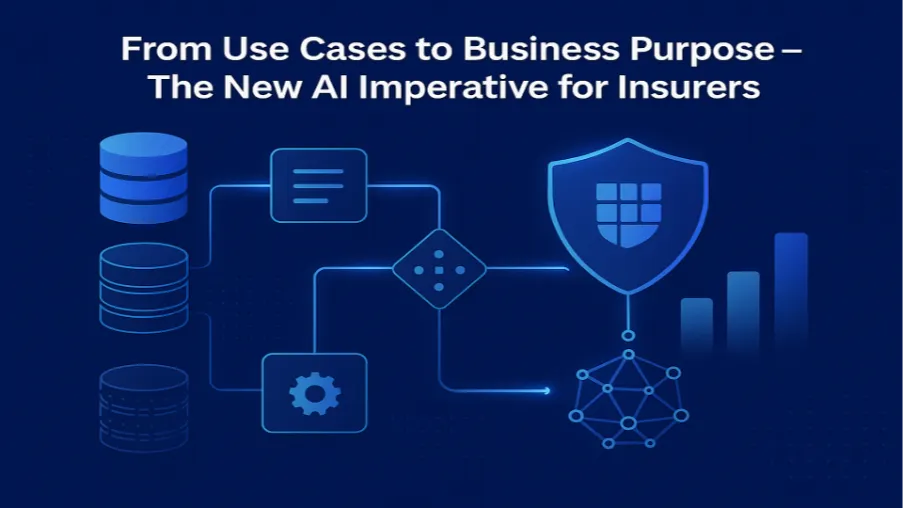
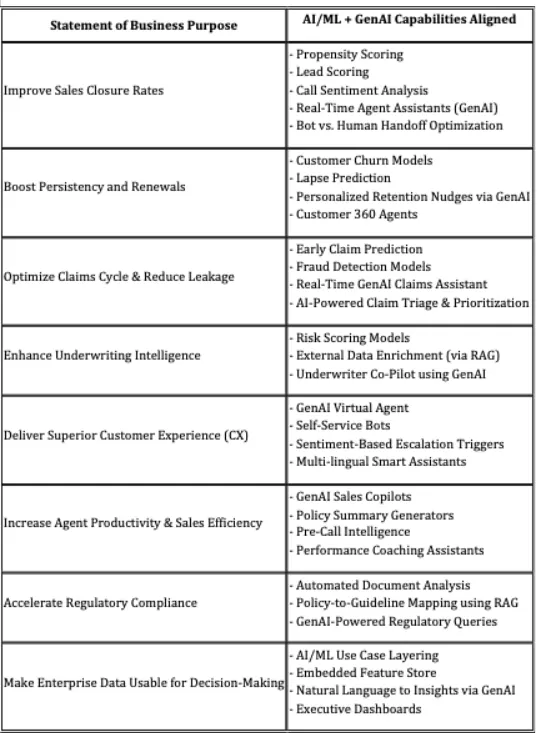
  • Moving from Use Cases to Business Purpose — The New AI Imperative for Insurers

    Moving from Use Cases to Business Purpose — The New AI Imperative for Insurers

    In the world of insurance, AI adoption is no longer a question of “why”- it’s about “how” and “what truly moves the needle.”

    At DSW, we believe the future of AI in insurance isn’t just about building individual use cases. It’s about aligning every use case — every model, every agent, every interaction — to a clear Statement of Business Purpose (SBP).

    Because when AI connects directly to what the business is trying to achieve, adoption becomes not just easier — it becomes inevitable.


    DSW UnifyAI: A Platform Built Around Business Purpose

    UnifyAI isn’t just a platform to build and deploy AI/ML or GenAI use cases — it’s a real-time AI engine designed to:

    • Understand enterprise context
    • Seamlessly integrate ML & GenAI workflows
    • Enable modular but interconnected AI systems
    • Deliver value at the point of business impact

    Our approach is simple: Start with your business purpose. Then, map the AI/ML and GenAI use cases needed to get there.


    What Do Business Purposes in Insurance Look Like?

    Here are a few key Statements of Business Purpose (SBPs), but not limited to -emerging across insurers, where we see AI gaining real traction:


    Why Is This Shift Important?

    When AI use cases operate in isolation, value stays fragmented.

    But when they are linked back to a unifying business purpose, here’s what changes:

    They’re easier to justify internally, outcomes are measurable and visible, AI adoption becomes part of the business rhythm, stakeholders across functions rally around impact, it unlocks cross-functional compounding value.


    The DSW UnifyAI Advantage

    DSW is not just bringing a platform. We’re bringing an AI operating layer, along with the expertise to walk with insurers through:

    • Aligning use cases to SBPs
    • Designing interconnected workflows (ML + GenAI)
    • Implementing fast: 30 days for AI/ML, 2–4 hours for GenAI readiness
    • Ensuring sustainable, governed, and scalable execution

    More than just an UnifyAI platform — we are a committed AI partner, co-owning the journey to embed intelligence into the very core of insurance workflows.

    Thought: AI That Understands Why

    AI adoption tied to “what the business cares about” isn’t just more impactful — it’s more sustainable.

    That’s the DSW UnifyAI difference.

    Let’s build for outcomes, not just experiments.

    Let’s align to purpose, not just pilots.

    Let’s make AI count — where it matters most.

  • The AI Imperative: From Experimentation to Operationalization

    The AI Imperative: From Experimentation to Operationalization

    In the world of technology, we often speak of “waves of change.” We saw it with the internet, with mobile, and now, with AI. Yet, if we look closely, AI isn’t one big wave; it’s a series of them — from the foundational machine learning models of a decade ago to the recent surge of generative AI, and the emerging tide of agentic AI. This constant evolution is both exhilarating and daunting for enterprise leaders everywhere.

    Nearly every organization has launched an AI pilot. The excitement is palpable; the potential, limitless. But there’s a quiet, sobering reality lurking behind the headlines. Far fewer of these experiments have successfully transitioned into scalable, production-grade capabilities that deliver measurable, and meaningful, business value. The statistics are stark: Only half of AI projects make it from the pilot stage to production, and for those that do, the journey can take as long as nine months. This isn’t just a minor hurdle; it’s a critical chasm that separates vision from reality. If your AI strategy is still circling the proof-of-concept phase, you’re not alone, but you are falling behind.


    The Problem with “Throwing in AI”

    In the face of rapid technological development and the fear of missing out (FOMO), it’s tempting to simply “throw AI” at existing problems. This approach, while seemingly a quick fix, often leads to a new layer of technical debt. It creates isolated point solutions — small, siloed automations that are hard to maintain, change, and evolve. This is a trap, a dead end that can stall an entire organization’s progress. We saw a similar pattern with Robotic Process Automation (RPA) over the last decade. While RPA provided quick wins, without a broader strategy, it often resulted in a messy patchwork of automations that became a maintenance nightmare. The same fate awaits those who fail to see the bigger picture with AI.

    The core issue lies in the operational gap. We’re great at building proofs-of-concept, but we lack the robust, adaptable architecture needed to bring these powerful technologies to life within complex enterprise environments. The spaghetti architecture of historically grown IT systems makes it nearly impossible to integrate and scale new AI capabilities seamlessly.

    ai-imperative-1

    The Right Action: A Unified AI Operating System

    So, what’s the right way forward? The answer is to create a process and operational architecture that achieves two critical objectives:

    1. Realize value today: You must have the ability to deploy and benefit from new AI technologies as soon as they are ready to drive real business value.
    2. Be ready for tomorrow: Your architecture must be flexible, scalable, and resilient enough to incorporate the “next big thing” in AI, even before we know what it is.

    This requires a fundamental shift from a project-based mindset to a platform-based one. We need a solution that serves as a central nervous system for AI, an Operating System for AI — one that is unified, secure, and production-ready from day one.

    Such a groundbreaking platform isn’t just another tool. It’s an end-to-end system that provides a seamless pathway from data integration to deployment and monitoring. It’s designed to be a complete solution with built-in AI and GenAI Studios, taking use cases from experimentation to production swiftly and at scale. It offers the kind of flexibility seen in leading public AI models, but entirely within your own infrastructure, with your data, your compliance, and your governance. It securely orchestrates AI and GenAI across on-premise, private, or hybrid cloud environments, with built-in guardrails for enterprise-grade security.

    ai-imperative-2

    ai-imperative-3

    The Groundbreaking Impact of a Unified Platform

    The benefits of this approach are transformative. By adopting an AI Operating System, enterprises can unlock unparalleled speed and efficiency, dramatically improving their return on investment (ROI). Imagine launching an AI use case in days, and a generative AI application in just hours. This is not a distant dream; it’s a reality.

    With a unified platform, organizations can:

    • Go live 50% faster and cut their total cost of ownership (TCO) by 60%.
    • Build, deploy, and scale their AI use cases in just 30 days, and GenAI in under 4 hours.
    • Automate complex processes like feature engineering, dramatically reducing the time and effort required for development and deployment.

    These aren’t just hypothetical gains. This approach has a proven track record of delivering real-world impact for clients across various sectors. For example, in the insurance industry, a leading company achieved 3X faster deployment for use cases like customer retention and persistency prediction. Another saw 80% data accuracy in identity matching, and a third reduced manual effort by 70% for policy retention with real-time risk prediction.

    In the banking sector, a financial institution achieved over 80% accuracy in detecting real-time anomalies, reducing their incident resolution time by 30%. Another bank’s real-time monitoring predicted customer defaults with over 85% accuracy, leading to a 20% reduction in loan loss provisions. The impact is equally significant in retail, where a customer reduced stock-outs by 40%, excess inventory by 50%, and improved inventory turnover by at least 40%. Another customer dropped return rates by 33% and reduced handling costs by 20%, driving repeat purchases and higher customer loyalty.

    These results are a testament to the power of a platform that is purpose-built for the enterprise, with an emphasis on scalability, security, and speed.

    ai-imperative-4

    The Path Forward

    The waves of AI will keep coming, and they are hard to predict. The key is to stop building isolated solutions and start building a foundation that can adapt to every new wave. A composable Enterprise AI Platform, acting as an operating system, provides this superpower. It allows you to realize value today, while being ready for whatever comes next.

    This is where the platform named DSW UnifyAI comes in. It is a composable Enterprise AI Platform with embedded intelligence. Its foundation is and will remain process orchestration, but it is expanding to all aspects of automation. Its key differentiators include:

    • Composability: An integrated yet flexible platform that seamlessly combines different technologies.
    • Embedded Intelligence: Features that fast-track development and allow for the orchestration of any AI technology, leading to reliable and secure autonomous orchestration.
    • Open Standards: The use of standards like BPMN and DMN to facilitate business-IT collaboration with one shared language.
    • Enterprise-Grade Scalability: A horizontally scalable, cloud-native, and highly resilient execution engine, battle-proven for mission-critical core processes.

    The era of AI experimentation is over. The time to operationalize has arrived. Smarter decisions with actionable intelligence.

  • From AI Adoption to AI Acceleration: What We’re Hearing on the Ground

    From AI Adoption to AI Acceleration: What We’re Hearing on the Ground

    In the past few months, something interesting has started happening in almost every conversation we’re having with enterprise leaders.

    The language has shifted.

    • From “Should we explore AI?” To “How fast can we scale it?”
    • And that single shift — from curiosity to conviction — changes everything.

    The AI Journey is Real, But It’s Not Linear

    Most enterprises we speak with are not starting from scratch. They’ve run pilots, tried a few PoCs, maybe even launched a use case or two in production.

    But here’s where it gets tricky: scaling that first success.

    It’s not that they lack intent. Or even ideas.

    It’s that every new use case starts to feel like reinventing the wheel:

    • New teams
    • New data pipelines
    • New infra challenges
    • New integration headaches

    That’s not scale — that’s repeat chaos.

    How do we make this “our AI journey” — not just another tech implementation?


    What’s Becoming Clear: Platform + Services is the Winning Formula

    If you’re in the trenches of AI adoption, you know this already: No single product will solve your problems. And no amount of consulting alone will make AI adoption sustainable.

    It has to be both:

    • A platform that gives you a repeatable foundation
    • Services that make that foundation real, contextual, and outcome-oriented

    This is not theory — this is the real-world formula that’s working.

    The smart enterprises aren’t just choosing tools.

    They’re choosing platforms that align with their business.

    And service teams that understand the domain, not just the tech.


    What Enterprises Are Telling Us They Want

     Whether it’s insurance, banking, logistics, or retail — the themes are consistent:

    – A way to move from one use case to many, without rework

    – Clear cost-benefit alignment from Day 1

    – No lock-ins — especially when it comes to data and models

    – Full transparency and control on how their AI is built and run

    • A partner that helps, not takes over

    – And above all, speed that doesn’t come at the cost of stability.


    Final Thought: AI Is No Longer “Next”

    We’ve crossed that phase.

    Now it’s about how fast, how sustainably, and how confidently you can scale it.

    Some will still stay stuck in experimentation.

    Others are already laying down their foundations to make AI an engine — not an experiment.

    If you’re in the second group, the real questions aren’t about whether AI works.

    They’re about how to make it work for your enterprise, your team, and your stack.

  • From Whispers of “Should We?” to a Roar of “How Fast?”: The AI Acceleration Imperative

    From Whispers of “Should We?” to a Roar of “How Fast?”: The AI Acceleration Imperative

    The air in enterprise leadership conversations has palpably shifted. The hesitant inquiries of “Should we explore AI?” have been decisively replaced by a resounding “How fast can we scale it?”. This single pivot, from mere curiosity to unwavering conviction, fundamentally alters the AI landscape.

    The AI journey, while undeniably real, is far from a linear ascent. Most organizations don’t start from a blank slate. They’ve dipped their toes in the water with pilots, navigated a few proofs of concept, and perhaps even launched a solitary use case into the live environment. But the crucial bottleneck emerges when attempting to replicate that initial success.

    It’s not a lack of ambition or even a shortage of innovative ideas that hinders progress. Instead, each new AI initiative feels like a Sisyphean task of reinvention: assembling fresh teams, constructing bespoke data pipelines, wrestling with novel infrastructure complexities, and untangling yet another web of integration challenges. This isn’t scalable growth; it’s a cycle of repetitive chaos.

    The dominant question echoing across boardrooms now is: “How do we inject predictability into this process?”

    The most critical and honest inquiries revolve around:

    • Building on Solid Ground: How do we prevent our AI initiatives from being built on shifting sands of uncertainty?
    • Exponential Velocity: How do we ensure that each subsequent use case is deployed with greater speed and efficiency than the last?
    • Trustworthy AI: How do we guarantee that our deployed models are rigorously governed, fully auditable, and inherently safe?
    • Unified Scalability: How do we architect a system that allows us to build once and then scale our AI capabilities with unwavering clarity?
    • Our Unique AI Identity: And, most importantly, how do we forge our distinct AI journey, rather than merely implementing another generic technology?

    The Unambiguous Answer: Platform + Services = Sustainable AI Power

    For those navigating the complexities of AI adoption, this truth has become self-evident:

    No standalone product can magically solve your AI challenges.

    And no amount of abstract consulting can, on its own, forge a sustainable AI future.

    The winning formula is a powerful synergy: 

    • A Robust Platform: Providing a repeatable and standardized foundation for all AI initiatives.
    • Strategic Services: Grounding that foundation in your specific context, driving tangible outcomes, and making the abstract real.

    This isn’t theoretical conjecture; it’s the proven equation driving success in the real world. Forward-thinking enterprises aren’t just selecting disparate tools; they are strategically choosing platforms that deeply align with their core business objectives. They are also partnering with service teams that possess a profound understanding of their industry, not just the underlying technology.

    The Unified Enterprise Demand: Clarity, Control, and Velocity

    Across diverse sectors – be it insurance, banking, logistics, or retail – a consistent set of demands is emerging:

    • Effortless Scalability: A clear pathway to move from isolated successes to widespread AI deployment without constant reinvention.
    • Tangible ROI: Clear and demonstrable cost-benefit alignment from the very outset of any AI project.
    • Freedom and Flexibility: No vendor lock-in, particularly concerning the crucial assets of data and AI models.
    • Unwavering Transparency and Control: Complete visibility and authority over how their AI is architected, built, and operated.
    • Strategic Partnership: A collaborator who empowers and guides, rather than dictates or takes over.
    • Sustainable Speed: The ability to accelerate AI initiatives without compromising stability or introducing undue risk.

    The Decisive Turning Point: AI Is Now

    The era of “next generation” AI is over. We have decisively crossed that threshold.

    The critical question now isn’t if AI works, but how swiftly, how sustainably, and how confidently you can scale its transformative power within your organization.

    Some will inevitably remain mired in perpetual experimentation. Others are already strategically laying the groundwork to transform AI from a series of isolated projects into a powerful, integrated engine of growth and innovation.

    If you belong to the latter group, your focus has rightly shifted. The fundamental questions about AI’s potential have been answered. Now, the vital inquiries center on how to tailor AI to the unique contours of your enterprise, empower your teams, and seamlessly integrate it into your existing technology stack.

    That’s the crucial conversation we’re here to facilitate.

    #DSWUnifyAI #DSWAIHub #EnterpriseAI #GenAI #AIAdoption #AIinBusiness #AITransformation #ResponsibleAI #AppliedAI #AIAcceleration #GoToProduction #AIatScale #AIDelivery #PlatformThinking